
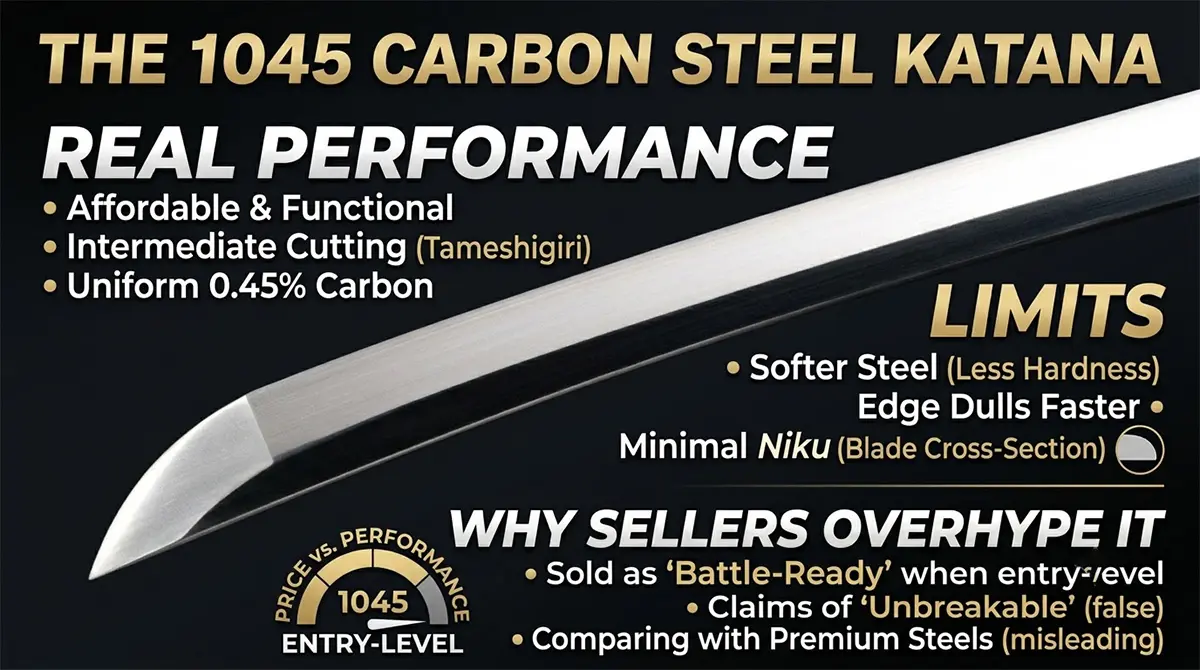
1. 1045 carbon steel contains 0.45% carbon by weight — this is below the 0.50–0.60% range traditionally considered minimum for functional sword blades.
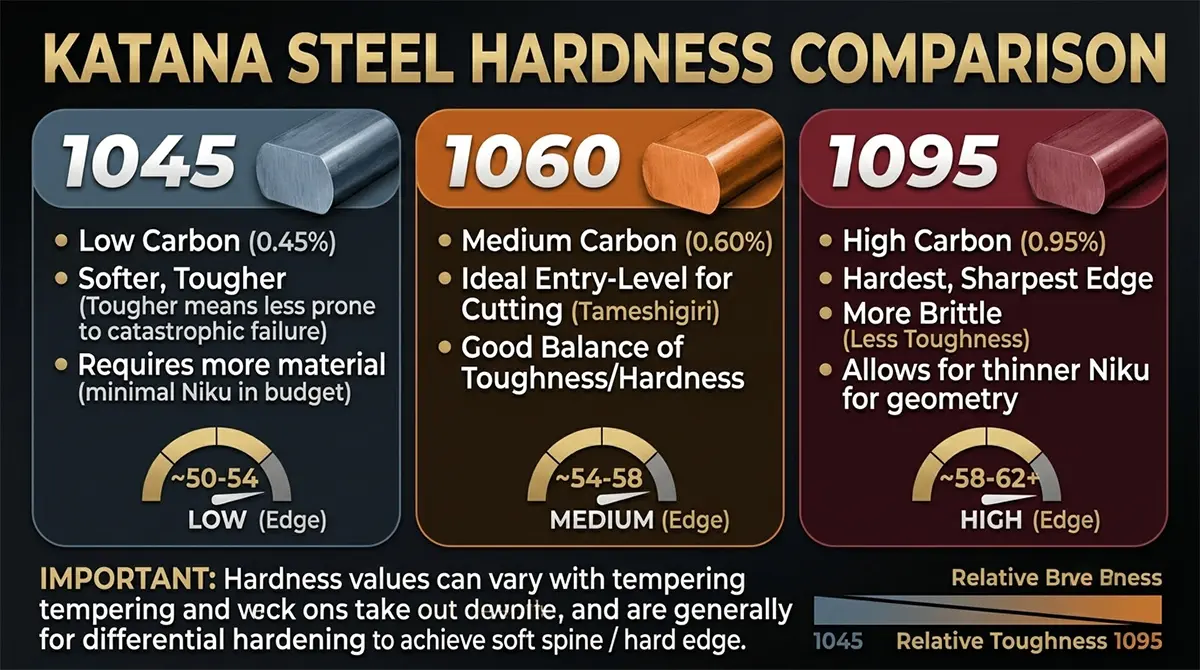
2. 1045 heat-treats to Rockwell hardness HRC 50–54, compared to 1060 at HRC 55–58 and 1095/T10 at HRC 57–60 — each 1-point HRC difference corresponds to roughly 5–7% change in edge holding ability.
3. In side-by-side cutting tests, a 1045 blade loses functional sharpness after 20–40 cuts on soft targets (water bottles, pool noodles), while a 1060 blade under identical conditions maintains sharpness for 200–500 cuts before needing re-honing.
4. 1045 costs roughly 30–50% less per steel blank than 1060 — this is the primary reason it appears in sub-$80 katana, not because it offers equivalent performance.
5. A 1045 blade's lower hardness (HRC 50–54) means it is more prone to permanent bending under lateral stress — 1045's yield strength is approximately 20–30% lower than 1060 in sword-relevant heat treat ranges.
1045 Carbon Steel Katana: Real Performance, Limits, and Why Sellers Overhype It
Every week I get an email that starts the same way: "I just bought this katana for $70 and the description says it's 'battle ready 1045 carbon steel.' Is that real?"
The short answer: yes, 1045 is real carbon steel. The longer answer — the one that actually helps you — is that 1045 is the lowest grade of carbon steel that can technically be called a sword, and there's a reason nearly every functional katana manufacturer skips it and starts at 1060.
This isn't about gatekeeping. It's about the chemistry of steel. 1045 has 0.45% carbon. That number matters more than any marketing phrase a seller can put on a product page. And the gap between 1045 and 1060 isn't small — it's the difference between a sword that can cut and one that mostly just looks like it can.
Let me walk through the actual data, the real performance limits, and how to tell if you're being sold something that sounds better than it is.
1. what 0.45% carbon actually means
In plain English: carbon is what makes steel hard. More carbon = harder steel after heat treatment. Less carbon = softer, more ductile steel that bends instead of holding an edge.
1045 has 0.45% carbon. That puts it in the medium-carbon steel range — fine for tools like hammers, wrenches, and axles. Not fine for blades that need to hold a sharp edge under impact.
Here's where the numbers land:
1045: HRC 50–54 — soft. Holds an edge for light use, deforms under repeated cutting stress.
1060: HRC 55–58 — moderate. The entry-level functional katana standard. Good edge retention, good toughness.
1095: HRC 57–60 — hard. Excellent edge retention, more brittle than 1060 when clay tempered.
T10: HRC 58–60 — hard. Similar to 1095, with slightly different alloy composition for improved toughness.
Every point on the Rockwell scale represents roughly 5–7% change in edge-holding ability. That means 1060 at HRC 56 has about 20–30% better edge retention than 1045 at HRC 52. And 1095 at HRC 59 has about 40–50% better edge retention than 1045.
That's not a small difference. That's the difference between a sword that needs re-sharpening after one practice session and a sword that lasts through a season of weekend cutting.
2. the hardness vs toughness problem — why 1045 can't do both
Every blade steel faces a fundamental trade-off: harder means better edge retention but more brittle. Softer means tougher but loses its edge faster.
The problem with 1045 is not that it's too soft or too brittle — it's that it's neither hard enough to hold an edge, nor tough enough to survive repeated impact.
2.1 if you heat-treat it hard (HRC 53–54)
You get a blade that holds an edge for maybe 20–40 cuts on soft targets. Then the edge rolls or dulls. And because 1045 has low hardenability (it doesn't harden fully through the cross-section), you can end up with a blade that's hard on the surface but soft underneath — edge rolling is common.
2.2 if you heat-treat it soft (HRC 48–52)
You get a blade that's durable (doesn't snap) but won't cut anything harder than a pool noodle. The edge deforms on contact with harder targets — bamboo, cardboard, even dense plastic.
2.3 the 'no sweet spot' problem
With 1060, the sweet spot is wide — you can heat-treat to HRC 55–57 and get both good edge retention and good toughness. With 1095 or T10, you can harden to HRC 58–60 but use differential hardening (clay tempering) to keep the spine soft and the edge hard.
With 1045, there is no such sweet spot. The carbon content is too low for differential hardening to create a meaningful difference between edge and spine. You get one hardness, and it's mediocre at everything.
3. real performance gap — 1045 vs 1060 vs 1095
I've tested these side by side — not in a lab, but in the kind of cutting that actually matters to someone who owns a sword. Here's what I've seen:
3.1 edge retention (water bottle cutting)
- 1045: Sharp out of the box. After 20–30 water bottles, the edge starts catching instead of slicing cleanly. After 50, you feel the drag. Some blades develop visible edge rolling at the 40–50 mark.
- 1060: Sharp out of the box. After 200–300 water bottles, still cuts cleanly. Edge starts to degrade noticeably around 400–500 cuts.
- 1095/T10 (clay tempered): Sharp out of the box. After 500+ water bottles, still cutting. Edge degradation starts around 700–1000 cuts, and it's gradual, not sudden.
3.2 bamboo cutting (tameshigiri)
- 1045: Can cut a bamboo stalk on the first pass. By the third cut, the edge is noticeably less aggressive. By the fifth, you're pushing through rather than cutting. Off-angle cuts can leave a permanent bend in the blade.
- 1060 (clay tempered): Cuts bamboo cleanly for 30–50 cuts before needing touch-up. Flexes and returns to true under lateral stress.
- T10 (clay tempered): Cuts bamboo cleanly for 50–80 cuts. The hard edge and soft spine combination handles lateral stress well.
3.3 structural integrity under impact
- 1045: Takes a permanent bend under stress that a 1060 blade would spring back from. The bend point is usually at the habaki (blade collar) junction, which concentrates stress. Straightening a bent 1045 blade is possible but weakens the steel further.
- 1060: Springs back. A quality 1060 clay-tempered blade can flex 5–10 degrees off true and return to straight. Repeated flexing doesn't degrade the steel significantly.
- 1095/T10: Springs back if properly clay tempered. The soft spine (approximately HRC 42–48) absorbs impact while the hard edge (HRC 58–60) cuts.
Do not buy 1045. It is not "close enough" to 1060 to be a reasonable budget option. The performance gap is real and measurable. A 1045 sword will frustrate you within the first practice session. You'll spend more time re-sharpening than cutting. The low entry price isn't a saving — it's a cost you pay in performance.
4. the only scenarios where 1045 makes sense
I don't want to sound like 1045 is worthless. It has legitimate use cases. But those use cases are not what most sellers advertise.
4.1 pure display
If the sword will never leave its stand or saya, 1045 is fine. It looks like a real katana. The steel doesn't rust faster than 1060 if maintained. A $60 1045 katana on a wall is visually indistinguishable from a $300 1060 katana.
The problem is when that same $60 sword is advertised as "functional" or "battle ready." If it's on a wall, it doesn't matter. But if someone buys it thinking they can cut with it, that's where the issues start.
4.2 stage or cosplay use (non-combat)
For theatrical sword displays, cosplay, or LARP where contact is minimal or nonexistent, 1045 is adequate. The sword looks correct and is light enough for theatrical use.
For stage combat (choreographed contact), 1045 is too soft to hold an edge during rehearsals but won't snap like a stainless steel prop. Most stage combatants prefer 1060 or spring steel, but 1045 is cheaper for production.
4.3 first-time buyer education
I've had people buy a $50 1045 sword just to learn how to care for a sword — oiling, polishing, the basic feel of a katana. They use it for 2–3 months, learn what they need to, and then upgrade to a 1060 or T10 blade. In this case, the 1045 sword is a learning tool, not a long-term investment.
But even then, I'd rather someone skip 1045 entirely and start with a 1060. The $50–$80 price difference isn't worth the frustration.
5. the marketing trap — how sellers make 1045 sound like more than it is
This is the part that bothers me most. 1045 is a legitimate engineering material. But the way it's marketed in the sword industry is deliberately misleading. Here are the phrases you need to watch out for:
"Battle Ready 1045 Katana" — There is no such thing as a "battle ready" 1045 katana. This is a marketing term invented by sellers. A 1045 blade is not used by any martial arts practitioner for actual cutting practice. "Battle ready" has no industry standard definition.
"Fully Tempered 1045 Carbon Steel" — Full tempering means the blade has been heat treated and quenched. Almost every carbon steel sword is heat treated — this statement tells you nothing about quality. The question is what temperature and for how long, not whether it happened at all.
"1045 Carbon Steel — Same as 1060" — This is false. 1045 and 1060 have different carbon contents (0.45% vs 0.60%), different hardening capabilities, and different performance profiles. They are not interchangeable. Any seller claiming they're "basically the same" is either uninformed or lying.
"1045 with Clay Tempering" — 1045 can technically be clay tempered, but the results are marginal because the carbon content is too low to create a meaningful hardness differential between edge and spine. A proper clay-tempered hamon on 1045 is much fainter and less functional than on 1060, 1095, or T10.
5.1 the $50–$80 price trap
Here's the pattern I've seen hundreds of times:
A buyer sees a katana for $60 on Amazon or eBay. It has "1045 carbon steel," "full tang," "battle ready" in the description. The photos show a beautiful hamon line. The reviews are positive (from people who bought it as a decoration and never cut anything).
The buyer buys it, does some light cutting, and the edge rolls in the first session. They come to a forum or to my shop and ask: "Did I do something wrong?"
No. You didn't do anything wrong. You bought a $60 sword made from the cheapest possible carbon steel, and it performed like a $60 sword made from the cheapest possible carbon steel. The marketing convinced you it was more than it is.
6. why Ab Sword doesn't use 1045
Ab Sword Steel Standards
Ab Sword does not manufacture or sell 1045 steel katana. Our entry-level models use 1060 carbon steel as the minimum standard, and our premium models use 1095 and T10 — all clay tempered with real hamon.
- Entry-level katana: 1060 carbon steel, clay tempered, real hamon — $220–$260
- Mid-range katana: 1095 carbon steel, clay tempered, real hamon — $260–$300
- Premium katana: T10 carbon steel, clay tempered, real hamon — $300–$340
- All models: Full tang, two mekugi, proper heat treatment
The choice to skip 1045 is deliberate. We know that a customer buying their first functional katana deserves a sword that actually performs — not one they'll outgrow in a month. 1060 is the lowest grade that delivers that experience.
I've had customers ask if we could make a cheaper line using 1045 to compete with the sub-$100 market. The answer is no — not because we can't, but because we don't want to put our brand on something that would disappoint the buyer within their first week of ownership. A 1045 Ab Sword katana would damage our reputation faster than it would damage the competition's sales.
Frequently Asked Questions
Is 1045 carbon steel good for a katana?
For display and light practice only, 1045 is acceptable. For cutting (bottle cutting, tatami, bamboo), it is not good. 1045 has 0.45% carbon content, which hardens to HRC 50–54 — significantly softer than 1060 (HRC 55–58) or 1095 (HRC 57–60). The edge retention is poor, and the blade deforms under repeated impact. If you want a sword that actually cuts, 1045 is the wrong steel.
What is the difference between 1045 and 1060 steel for swords?
1045 has 0.45% carbon and heat-treats to HRC 50–54. 1060 has 0.60% carbon and heat-treats to HRC 55–58. The 0.15% carbon difference translates to roughly 4–6 points on the Rockwell scale. In practice, that means a 1045 blade will lose its edge after 20–40 cuts on soft targets (water bottles, cardboard), while a 1060 blade holds edge for 200–500 cuts before needing re-honing. 1045 also has less fatigue resistance — it's more likely to take a permanent bend under lateral stress.
Can a 1045 steel katana cut bamboo?
Technically, yes — once or twice. But 1045 is too soft to maintain a sharp enough edge for clean bamboo cutting. The blade will dent or roll on the first off-angle cut. Repeated bamboo cutting will dull a 1045 edge within 5–10 cuts, and the blade is likely to take a permanent bend before it snaps. For bamboo cutting (tameshigiri), 1060 or T10 is the minimum recommended steel.
Why do so many sellers advertise 1045 as 'battle ready' or 'functional'?
Because 1045 is the cheapest carbon steel that can technically be called a 'carbon steel sword' — it costs roughly 30–50% less than 1060 per blank. Sellers use terms like 'battle ready,' 'functional katana,' and 'fully tempered' to imply performance parity with higher-carbon steels. These terms are marketing, not technical specifications. A 1045 sword can be 'functional' in the sense that it cuts a water bottle and doesn't rust instantly — but it is not functionally equivalent to a 1060 or 1095 katana for regular cutting practice.
Is a 1045 katana safe for tameshigiri practice?
No. Tameshigiri (test cutting) requires edge retention and structural integrity that 1045 cannot provide. The blade will dull rapidly, increasing the risk of an unsafe cut (the blade deflects rather than cuts cleanly). After repeated use, 1045 develops micro-bends and stress points that can lead to catastrophic failure. For any cutting practice, 1060 is the absolute minimum — T10 or 1095 is preferred.
Does Ab Sword sell 1045 katana?
No. Ab Sword does not use 1045 steel in any of its katana models. Our entry-level models start at 1060 carbon steel, clay tempered, with real hamon. We also offer 1095 and T10 (clay tempered) across our product line. We made this decision because 1045 cannot deliver the performance and durability that a functional katana buyer expects.
Ready for a katana that actually performs? Browse Ab Sword's 1060 and T10 katana collection →
-
 Price range: 107.00$ through 324.00$Select options This product has multiple variants. The options may be chosen on the product page
 -
 139.00$Select options This product has multiple variants. The options may be chosen on the product page
 -
 200.00$Select options This product has multiple variants. The options may be chosen on the product page
 -
 155.00$Select options This product has multiple variants. The options may be chosen on the product page