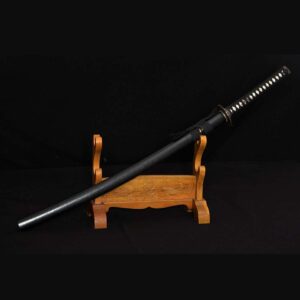
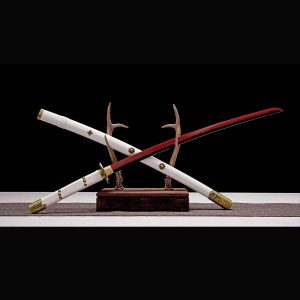
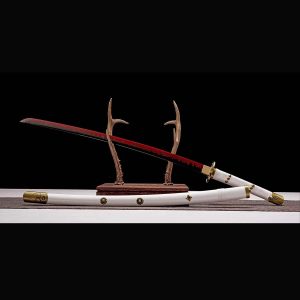
In the shadowy international of feudal Japan, wherein stealth and precision had been subjects of life and loss of life, the ninja sword—those enigmatic warriors of the night—depended on tools as precise as their exchange. among their maximum iconic weapons is the ninja sword, a blade shaped now not with the aid of the grandeur of samurai honor, but through the gritty demands of espionage, assassination, and survival. but what genuinely defines a ninja sword? It isn’t simply a weapon with a curved blade; rather, it’s miles a masterclass in purposeful layout, born from the want to move unseen, strike hastily, and adapt to the chaos of covert struggle. To apprehend its essence, we should delve into its records, craftsmanship, and the precise traits that set it aside from the greater celebrated samurai blades like the katana.
The Roots: Ninja Swords vs. Samurai Katanas
Samurai Katanas, such as the katana and tachi, had been symbols of reputation and bushido (the way of the warrior). solid with meticulous care, they featured lengthy, lightly curved blades (generally 60-seventy three cm) designed for open fight, where a unmarried, decisive strike may want to flip the tide of struggle. Samurai wore their katana with the threshold facing up, suspended from a belt referred to as an obi, a style that introduced their presence as a good deal as it prepared them for combat.
Ninja swords, via comparison, have been tools of discretion. Ninjas, or shinobi, operated out of doors the samurai elegance, regularly employed as spies, saboteurs, or mercenaries. Their blades had to be compact sufficient to cover under loose apparel, strong enough to pierce armor or spoil via barriers, and flexible sufficient to function gear—prying open doors, digging holes, or even acting as a lever. This practicality gave start to a awesome sort of blade known as the ninjato (literally “ninja sword”), although historians debate whether this term changed into coined later to romanticize the weapon.
Key Raits of a Ninja Sword
1. Blade Length and Shape
The most obvious function of a ninja sword is its shorter duration. not like the katana, which averages 60 cm or more, a regular ninja sword measures between forty-50 cm. This compact length made it easy to hide—strapped to the lower back, hidden in a sleeve, or tucked into a fold of the ninja’s shinobi shōzoku (conventional outfit). The blade’s curve is also extra diffused, occasionally nearly straight, making an allowance for short stabs in restricted areas like narrow alleys or inside buildings.
2. Hilt and Handle (Tsuka)
The tsuka (deal with) of a ninja sword is regularly shorter than that of a katana, designed for a one-exceeded grip—important for scaling walls or fighting at the same time as in movement. not like samurai swords, which may additionally feature tricky menuki (ornamental steel adorns) or tsuka-ito (wrapping) with family crests, ninja sword handles had been plain, wrapped in long lasting wire to save you slipping during wet or sweaty situations. a few even had hollowed handles to save small gear like lockpicks, poison darts, or fire starters—vital for a ninja’s mission.
3. Shield (Tsuba)
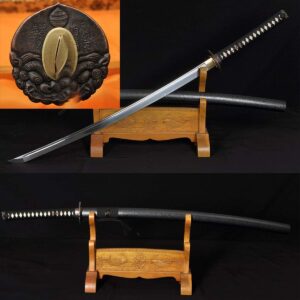
The tsuba (shield) of a ninja sword is some other telltale signal. Samurai tsuba were often massive and ornate, crafted from metallic with difficult designs to reflect the owner’s popularity. Ninja tsuba, however, had been small and easy, occasionally even square or square in preference to circular. This decreased length avoided the protect from catching on garb or equipment throughout stealthy movement. In a few instances, the tsuba may want to double as a tool—its flat surface used to hammer nails or smash glass.
4. Blade Construction (Hada and Hamon)
Even as samurai blades have been solid using the tamahagane (excessive-carbon metal) and folded heaps of instances to create a patterned hada (grain) and a distinct hamon (mood line), ninja swords prioritized sturdiness over splendor. Many were crafted from decrease-grade metal, although still sharp enough to pierce flesh and mild armor. The hamon on a ninja sword is often much less reported, and the hada may additionally lack the difficult patterns of a katana. This isn’t to say they had been poorly made—as a substitute, their craftsmanship focused on capability: a blade that could withstand repeated use, upkeep, and harsh situations without breaking.
5. Sheath (Saya)
The saya (sheath) of a ninja sword become as sensible as the blade itself. crafted from wood wrapped in leather-based or lacquered to repel water, it regularly had a clean, streamlined form to decrease noise while drawing the sword. some saya featured hidden compartments or have been designed for use as a respiratory tube whilst crossing rivers underwater—a trick ninjas used to avoid detection. not like samurai saya, which is probably adorned with clan symbols, ninja sheaths were undeniable, blending into the darkness of night.
Misconceptions and Myths
Famous way of life often portrays ninja swords as mystical guns with supernatural houses, however in reality, they had been grounded in practicality. One common fable is that every one ninja swords have been immediately, but whilst many had minimal curvature, a few featured a mild bend to balance reducing and thrusting competencies. any other misconception is they had been solely utilized by ninjas—farmers, merchants, and occasional-ranking warriors also used comparable short blades for self-protection, as samurai regulation constrained commoners from carrying lengthy swords.
It is also crucial to differentiate the ninja sword from the wakizashi and tantō. A wakizashi is a brief sword (30-60 cm) worn by samurai as a secondary weapon, regularly paired with a katana in a fixed called daishō. A tantō is a dagger (much less than 30 cm) used for near-quarters combat or seppuku (ritual suicide). Ninja swords, even as comparable in length to those, have been designed for a different motive: stealth and utility over rite or honor.
The Ninja Sword in Motion
To recognize why these features mattered, believe a ninja infiltrating a castle beneath cover of night. mountaineering a stone wall, they need a blade quick sufficient to now not snag on ropes or bricks—for this reason the forty cm length. reaching a locked door, they use the hole tsuka to retrieve a lockpick. as soon as inside, a guard spots them; the ninja attracts the sword in a single fluid movement, the small tsuba preventing the blade from catching on their apparel. in the restrained corridor, the straight blade allows for brief stabs, at the same time as the long lasting metal holds up in opposition to the defend’s armor. Escaping through a window, they use the saya to interrupt the glass silently, then vanish into the night. every part of the sword serves a purpose, turning chaos into opportunity.
Current Interpretations
These days, ninja swords are celebrated in martial arts, collectibles, and pop culture. Martial artists practice ninjutsu with replicas that mimic the unique layout, emphasizing velocity and precision. creditors searching for out antique examples, although authentic feudal-generation ninja swords are rare—many have been discarded or destroyed after the Edo duration, while ninjas dwindled into legend. contemporary forges, however, keep to craft ninja swords the use of traditional strategies, mixing historic accuracy with contemporary steelmaking to honor their functional legacy..
Ninja Sword Standard Definition
A ninja sword is defined now not via a single trait, but through the harmony of its parts: a quick, subtly curved blade for stealth, a undeniable hilt and shield for practicality, and a sheath designed to serve as extra than only a covering. it’s miles a weapon formed by necessity, reflecting the ninja’s code of adaptability and survival. not like the samurai’s katana, which shouted its proprietor’s glory, the ninja sword whispered—its energy mendacity in its capability to stay unseen till the moment it mattered most.
in the end, what training as a ninja sword is straightforward: it is a blade that does not just kill, but survives—as versatile and resilient as the warriors who wielded it. And though the age of ninjas has handed, their swords continue to be a testomony to the ingenuity of folks that fought no longer with honor on their sleeves, but with shadow in their hands.
-
Original price was: 236.00$.136.00$Current price is: 136.00$.Select options This product has multiple variants. The options may be chosen on the product page
-
Original price was: 126.00$.116.00$Current price is: 116.00$.Select options This product has multiple variants. The options may be chosen on the product page
-
Original price was: 227.00$.137.00$Current price is: 137.00$.Select options This product has multiple variants. The options may be chosen on the product page
-
Original price was: 226.00$.126.00$Current price is: 126.00$.Select options This product has multiple variants. The options may be chosen on the product page